
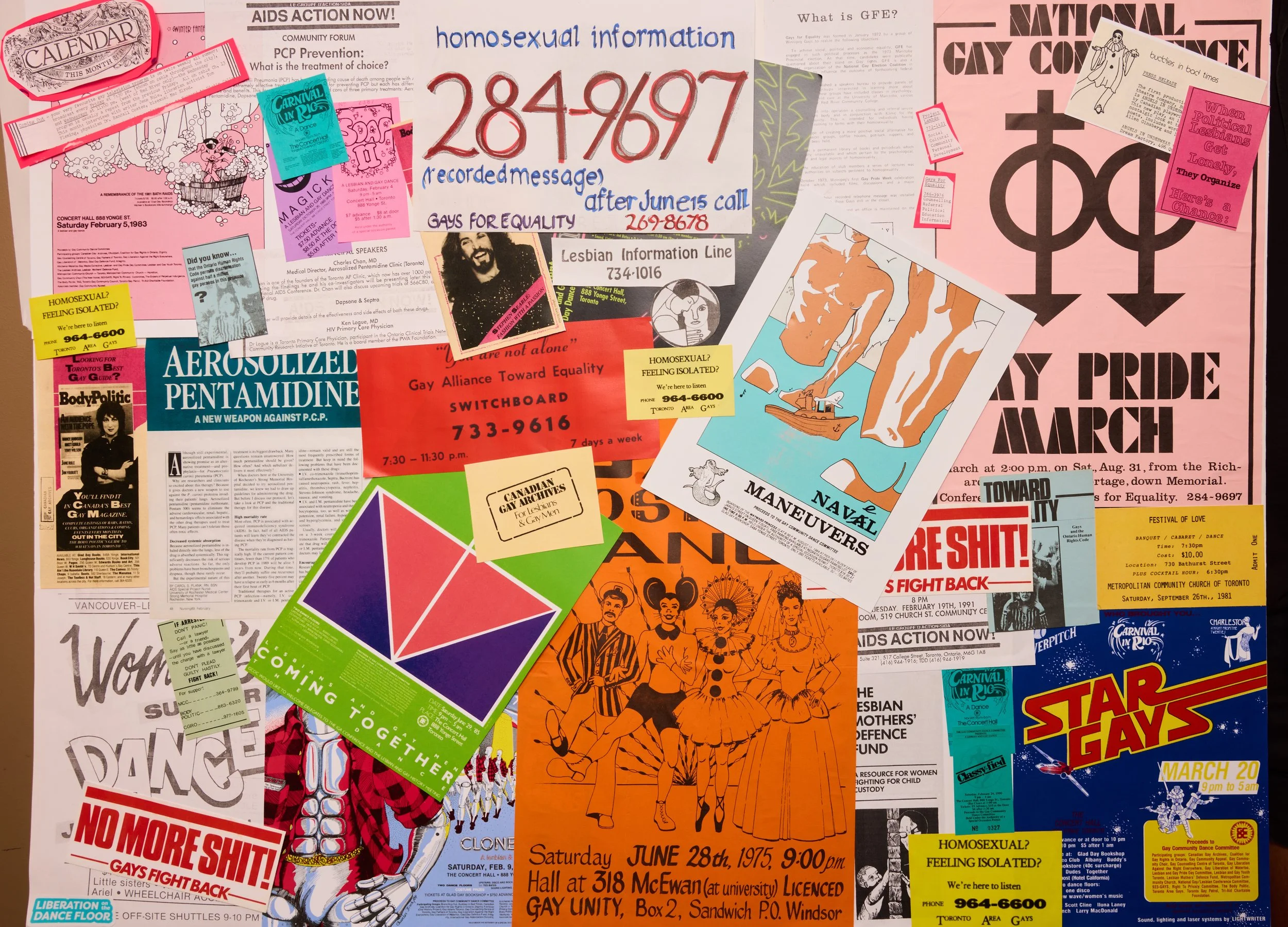
LESBIAN INFORMATION LINE - VANCOUVER, BC - CALL NOW:
(604) 734-1016
LESBIAN INFORMATION LINE - VANCOUVER, BC - CALL NOW: (604) 734-1016
Winnipeg’s Gays for Equality (GFE) was a student group based out of the University of Manitoba. They opened a phone line in 1972 and ran it until 2012, providing peer counseling from 7:30 to 10 pm, Monday through Friday. The phone line was intended to foster community outreach and helped support GFE’s activism in the local gay and lesbian communities, their creation of an educational library, and their eventual expansion into a community centre.
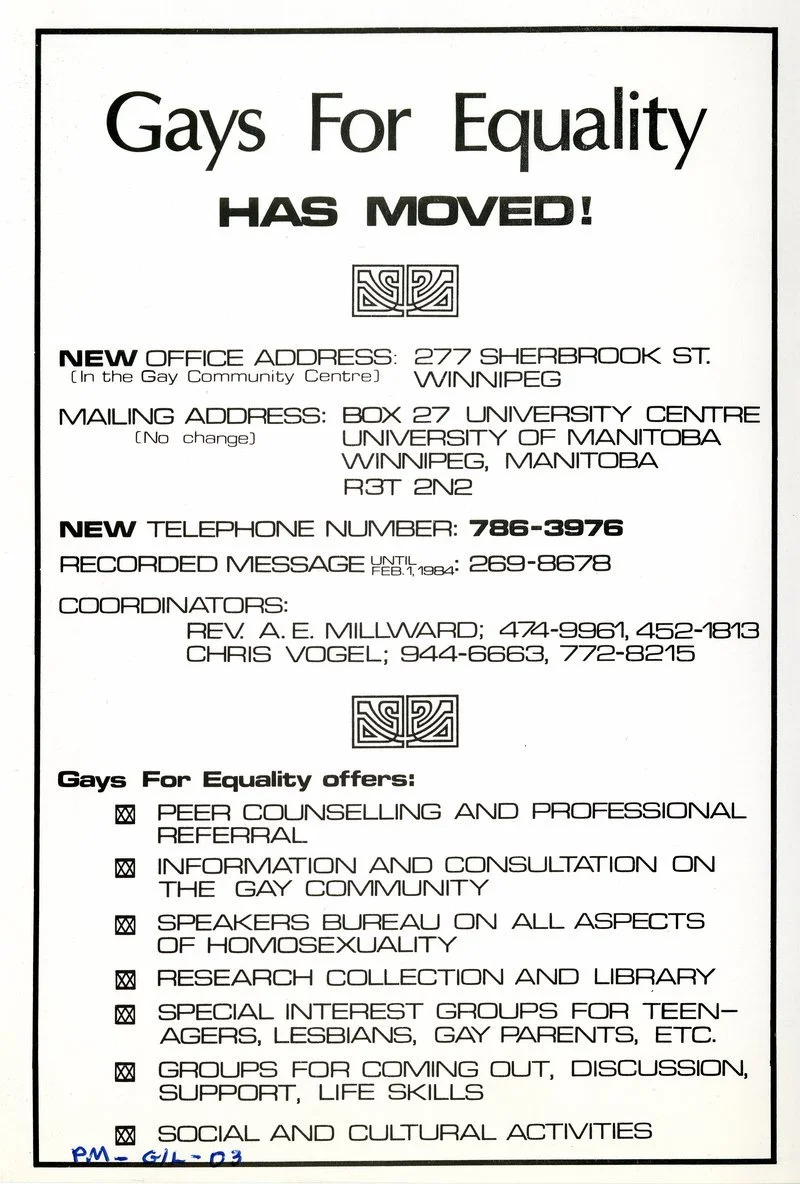
GFE Office Move Flyer. Date Unknown.
Gays for Equality (GFE) evolved from the Gay Social Club student group based out of the University of Manitoba. GFE branched off in 1972 to focus on community work for queer rights within the greater Winnipeg area. Their first initiative was to establish a phone line, which ran out of an office in the university. Its 24-hour recorded message comforted callers, assuring them that they were not alone, and volunteers answered the phone and provided peer counselling from 7:30 to 10 pm Monday through Friday.GFE wanted the phone line to foster community among queer individuals who were seeking guidance. On average, they received ten calls per weeknight shift and “in 1982 GFE volunteers were on duty on 246 evenings and answered 2500 calls [1].”
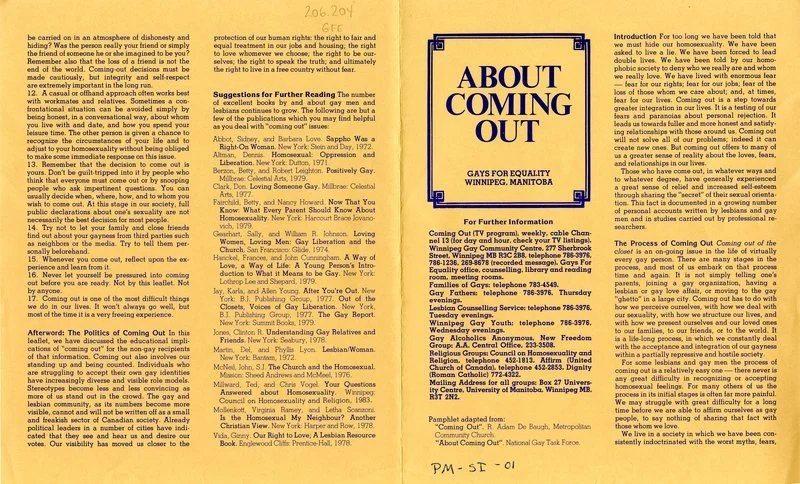
GFE “About Coming Out Flyer. “ Date Unknown.
As Valerie J. Korinek writes, “the three-minute message, which was changed frequently, offered an anonymous way for Winnipeg residents to learn about gay activities in the city [2].” The phone line was immediately popular and its anonymous nature fostered a safe way to engage with the gay community both in secret and publicly. Additionally, “GFE faced a number of obstacles to setting up the phone line, and these obstacles make clear the ways in which various governmental, media, and commercial organizations engaged in a clear form of obstructionism to ‘protect’ citizens from hearing or reading about homosexual-ity [3].” GFE’s phone line stood in opposition to the social prejudices and governmental restrictions of the time; its very existence an act of protest. Similarly to other phone lines, GFE sought to be the first point of contact for the LGBTQ2+ community in Winnipeg, and through its availability as a resource, brought significant visibility to the fight for equal rights happening across the country. By maintaining a sense of visibility for gay people in a prejudicial time and by building a strong community presence through outreach, GFE was able to advocate for equal rights in Winnipeg. Most notably, GFE's primary goal was to push for marriage equality and changing the Manitoba Human Rights Code to list sexuality as a basis for discrimination. Thanks to GFE and other community activist group efforts, sexuality was added to the Manitoba Human Rights Code in 1987.
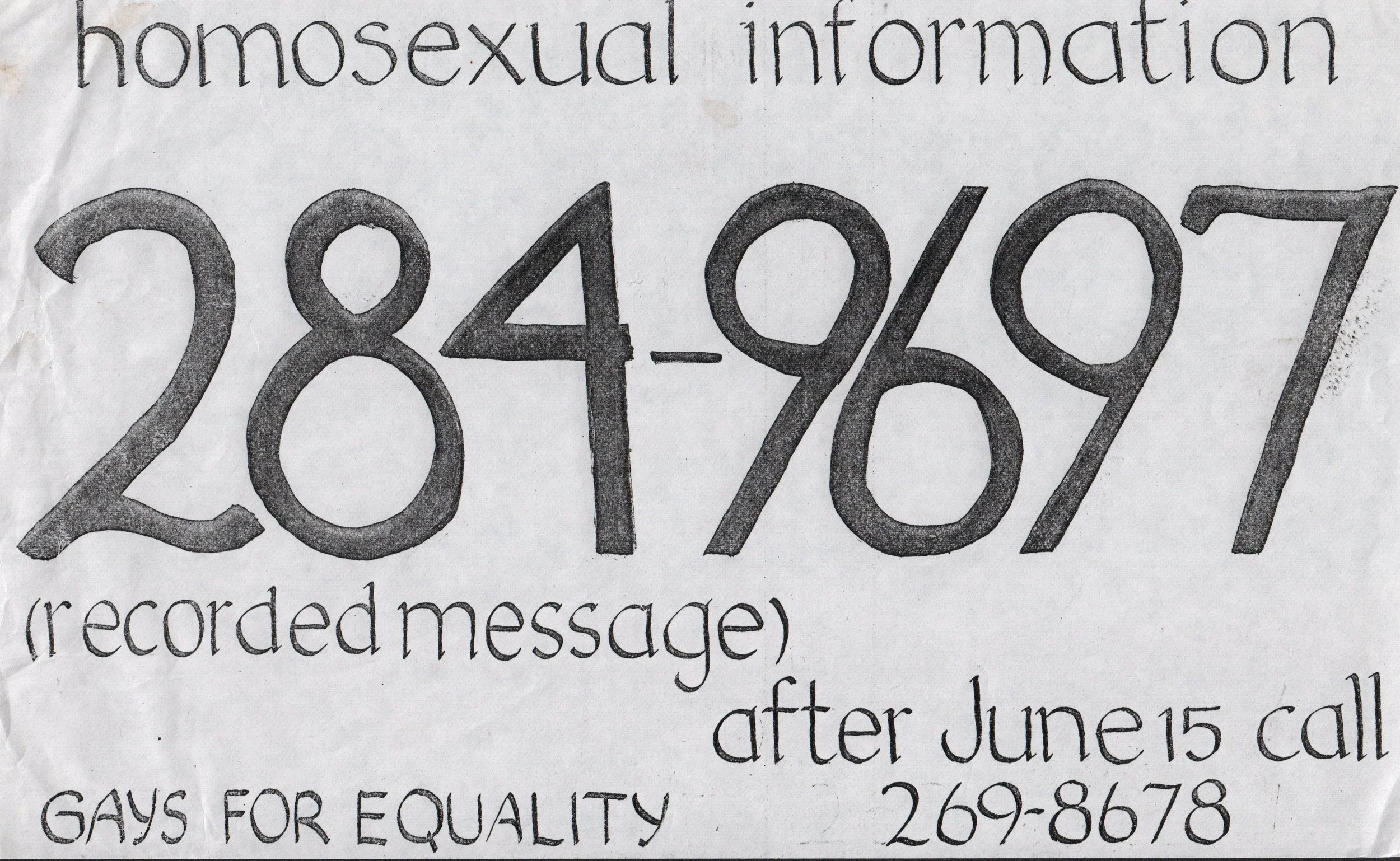
GFE Phone Number Handout.
Chris Vogel and Rich North, two prominent members of GFE who met through the organization, became the first gay couple to get married in a Canadian church in 1974, officiated by the pastor Ted Millward. Although Manitoba courts did not officially recognize the union, the news surrounding their marriage united gay advocacy groups in the area, and brought equal marriage rights to the public’s attention. Their union, officiated by a gay minister, demonstrated how another facet of Winnipeg’s gay and lesbian community…was the significant number of organizations devoted to the intersection of faith and sexual orientation. Those originated because the volunteers staffing the GFE phone lines took many calls from queer Mennonites and Catholics who were grappling with both their sexual-ity and their faith [4].
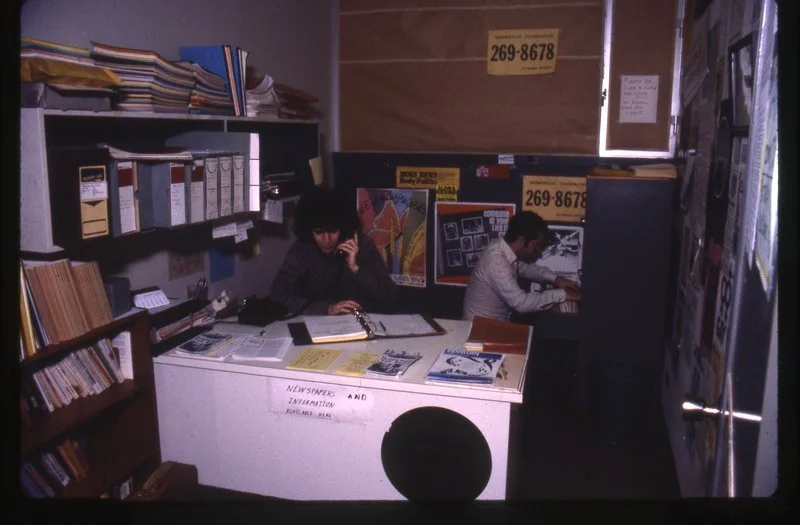
GFE Interior Office, 1981.
The peer counselling done on GFE’s phone line was successful in reaching a broad audience, both geographically and culturally. Queer individuals from all backgrounds, faiths, and experiences could call in to seek out education or get involved in advocacy efforts. While it began as a student group, setting up the phone line fostered outreach, building connection with queer individuals in the wider Winnipeg community. Building upon the successes of the phone line, GFE targeted activism for the gay and lesbian community, maintained a library and created resources for education, and eventually expanded to a community centre. GFE was involved in Project Lambda, an “apolitical agency whose objectives were to promote public understanding and acceptance of homosexuality in Manitoba [5].” In this sense, GFE…was the driving force for education, counselling, culture, and liberationist politics in the city. Drawing upon a small nucleus of gay male activists, notably the duo of Richard North and Chris Vogel, GFE offered wide-ranging services—indeed it approximated a gay social services organization, with its information and counselling hotline; various support and information groups; coffee houses; library; and at various times, newsletters and cultural materials [6].
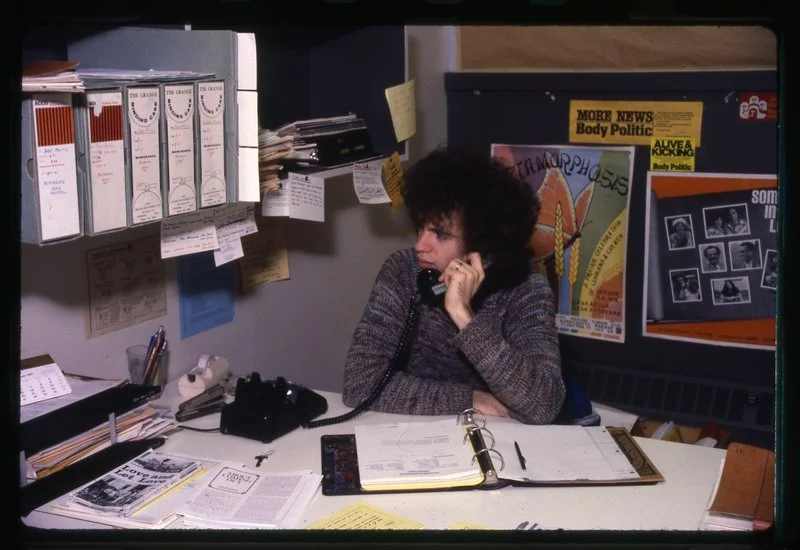
David Granger opening GFE LIne, 1981.
Chris Vogel went on to be treasurer of GFE, while Rich North organized the National Gay Conference that kickstarted Winnipeg’s first Pride March and Pride Week. Additionally, North was involved in broadcasting “Coming Out!” on TV and “Gaysweek” on the radio, both programs geared toward showcasing various aspects of queer life in the Winnipeg area, including public interviews. GFE’s phone line was the crucial starting point for almost all Winnipeg-based organizations that advocated for gay rights. By creating accessibility and visibility, GFE created community safe spaces and educated the public.
GFE built the Winnipeg Gay Centre in 1983, which was reopened in 1988 as the Winnipeg Gay/Lesbian Resource Centre before finally becoming the Rainbow Resource Centre in 1999, which still exists today. The phone line continued until 2012, making it the longest-running gay phone line in Canada [7]. The impact of GFE’s phone line is far-reaching, as it helped to fundamentally change the conditions and social understanding of queer individuals in Winnipeg and Canada more broadly. By creating a space that could both educate and comfort the caller, GFE built a strong community that was willing to get out in the streets to fight for change.
↓ Bibliography ↓
[1] Millward, Ted. “Gays for Equality-A History/Appreciation.” Out and About, April (1983): 4. Archives of Sexuality and Gender, link.gale.com/apps/doc/QWHHRV796074045/AHSI?u=rpu_main&sid=summon. Accessed April 29, 2025.
[2] Korinek, Valerie J, Prairie Fairies: A History of Queer Communities and People in Western Canada, 1930-85. University of Toronto Press, 2018.
[5] “Manitoba Gay and Lesbian Archives (Winnipeg, Manitoba).” History of Medicine & Medical Humanities. https://medhumanities.ca/lam/manitoba-gay-and-lesbian-archives-winnipeg-manitoba/. Accessed April 29, 2025.
[6] Korinek, Prairie Fairies, 157.
[7] “Historical Timeline.” Rainbow Resource Centre. https://rainbowresourcecentre.org/historical-timeline.