
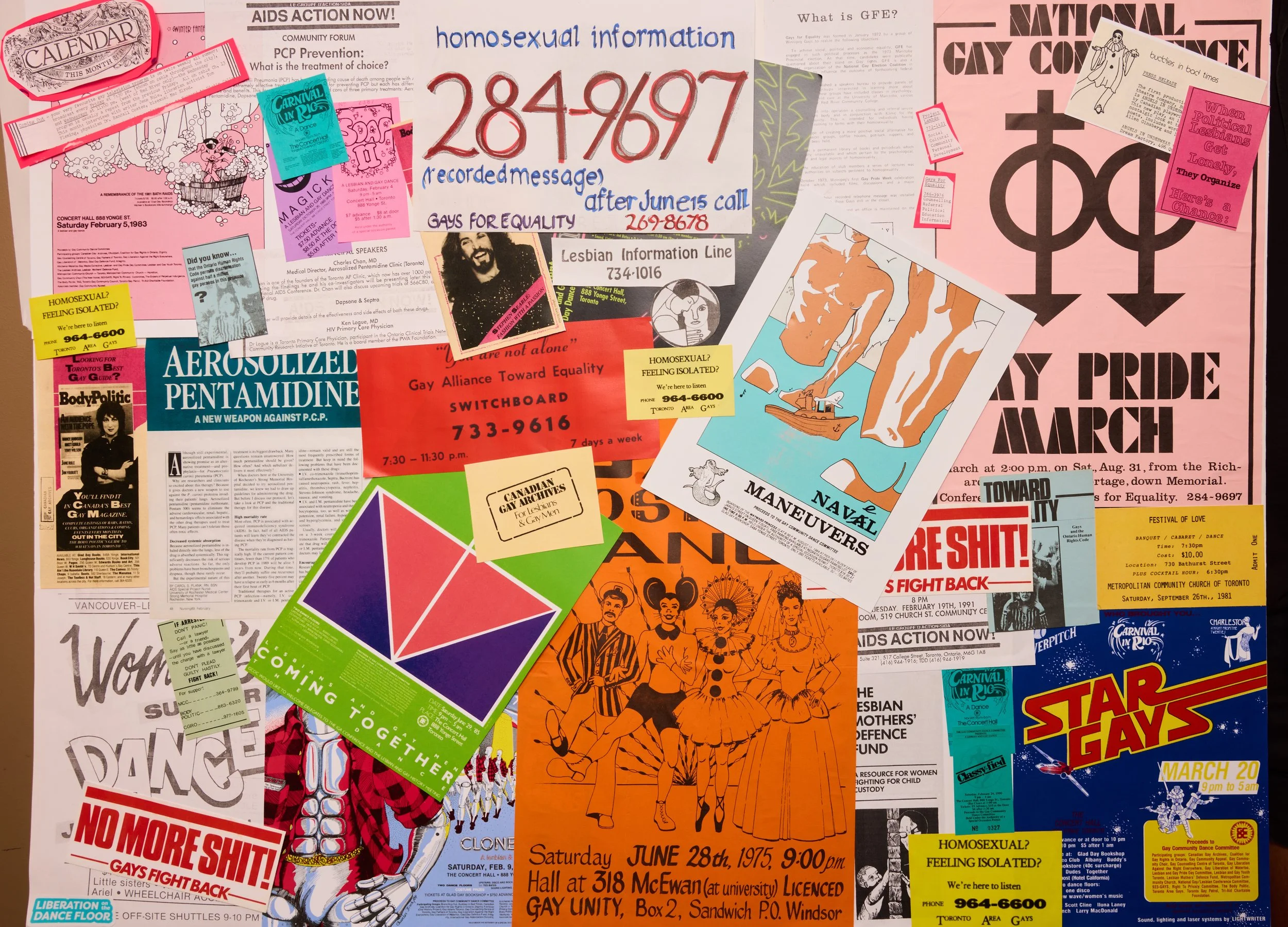
Here to listen.
From the early 1970s to the late 1990s, phone lines were central to queer community building and collective organizing across Canada. Various activist organizations staffed phone lines to share information to connect people in their local communities. Primarily run by volunteers, they provided callers with crisis services and emotional support, information about upcoming queer events, and LGBTQ2+ community resources. The purpose of these phone lines was to provide queer locals with a source that connected them to others in their community, fostering visibility, resistance and solidarity at a time where queer lives were constantly under attack.
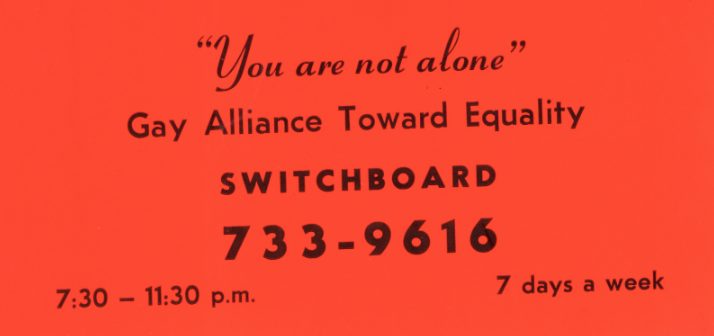
Ad for Gay Alliance Toward Equality’s Switchboard,
c. 1970s.
Our case studies currently include phone lines based in Toronto, Vancouver, Halifax, and Winnipeg. Despite their popularity in the 1970s and 80s, by the late 90s and early 2000s most phone lines shut down due to funding issues, the rise of alternative communication technology, and broader shifts under neoliberalism that privilege certain formations of community. In the early years of the lesbian and gay liberation movement, phone lines functioned as important sites of activism that built community and formed resistance to institutional prejudice and interpersonal discrimination. As we have learned from the activists who ran them, the anonymity provided by phone lines allowed individuals to call without fear of surveillance and social repercussions. For many Canadians throughout the 1970s and 1980s, phone lines were an initial step in their journey towards self-acceptance and the first point of contact with the broader LGBTQ2+ community.
Phone lines were advertised through various means, including gay and lesbian newsletters, radio and television shows, and community events. Word of mouth was particularly important in advertising, and community members spread information in conversation by passing around cards and posting stickers in public spaces—on bus stops, telephone poles, in subways, and most frequently, in public washrooms [1]. At times, phone lines were also listed in telephone books and Yellow Pages under “social services [2],” however, mainstream networks were sometimes unhelpful, or even hostile [3].
Ad for Toronto Area Gays, 1977
LGBTQ2+ phone lines operated differently depending on the organization, meaning that callers might hear pre-recorded information or be connected with a volunteer available to chat. Pre-recorded messages provided vital knowledge, such as general information on homosexuality, referrals to organizations and resources, and information about regular community events. For example, the Gay Community Calendar’s (923-GAYS) voicemail listed gay community events, keeping callers up to date on local functions and gatherings. Pre-recorded messages were also less intimidating, as callers could simply dial up and listen without the pressure of speaking to someone.
Peer support counselling, sometimes also referred to as “kitchen table counselling,” allowed ordinary people to speak to one another without the formality of a professional interaction. Simply having someone to listen and offer emotional support was highly beneficial in providing a crucial entry point into the community, being less intimidating and more accessible than face-to-face conversations or community events [4]. Phone lines allowed callers to be as anonymous as they wished while providing them with a sense of support and community. The goal of conversational phone lines was to make people feel heard and accepted in the queer community and offset feelings of isolation, fear, self-censorship, social rejection, and loneliness [5].
Volunteers were responsible for answering the phone, organizing events, and looking for funding. They offered informal peer counselling and often had to deal with the annoyance of hang-ups or prank calls, which wore down morale due to their high volume. Volunteers were also expected to maintain call log records, in which they wrote down information about each call such as the date, reason for calling, and the advice or information provided. Volunteers were intrinsic to the operation of these phone lines and should be understood as important activists in the ongoing project of Canadian queer liberation.
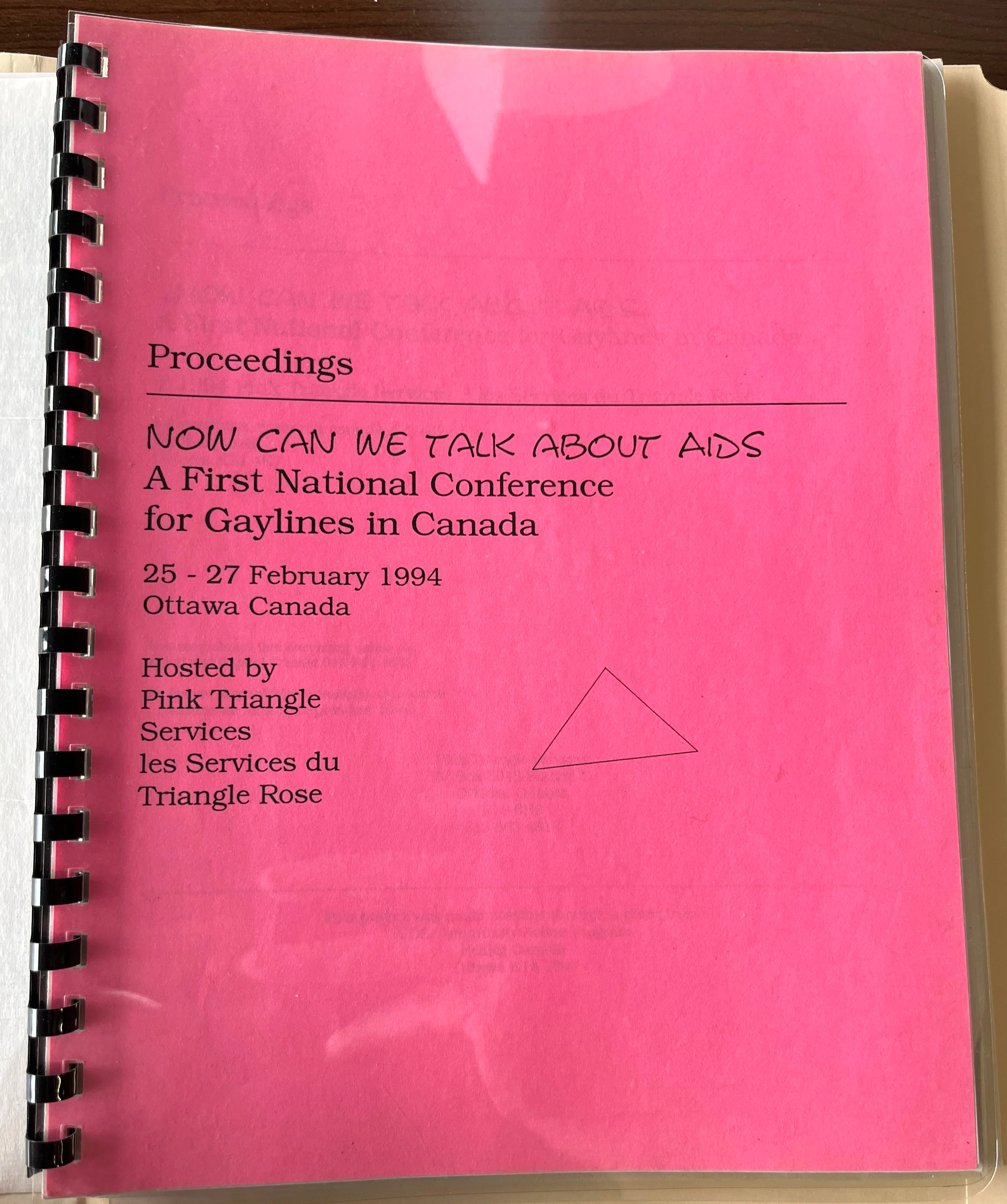
Document Covering the Proceedings and Agenda of Now Can We Talk About AIDS: A First National Conference for Gaylines in Canada.
For many volunteers, the experience of serving on community-run phone lines drew them into other types of activism. In Prairie Fairies, Valerie Korinek quotes Jane Smith, a nurse who volunteered on the GAE’s Gayline during the 1970s and 1980s. Smith states that hearing callers’ ‘“horrendous stories of lobotomies, and shock treatment, just because somebody found out they were gay [or] lesbian”’ was “‘the driving force’ for her committee work and activism [6].” The phone line format itself was also useful for different types of activism, as evidenced by the formation of the Pentamidine Project by AIDS Action Now! (AAN), which became an extension of their established work in AIDS activism. While most phone lines focused on linking individuals to the queer community, the Pentamidine Project’s activism connected individuals to information on how to access the life-saving drug [7].
Phone lines were a foundational form of activism for LGBTQ2+ individuals and organizations of the 1970s and 1980s. In her book Information Activism: A Queer History of Lesbian Media Technologies, Cait McKinney argues that lesbian phone lines are particularly unique in transforming active listening between two women on the phone into a political act [8]. Educating callers—including straight people—was a priority for many phone lines, with the goal of shifting negative public perceptions about gay people. Korinek describes the obstacles that governmental, media, and commercial organizations created to prevent the setup of phone lines, describing this as “a clear form of obstructionism to ‘protect’ citizens from hearing or reading about homosexuality [9].” This highlights the sociopolitical power held by queer phone lines, for their insistence on operating despite social, political and institutional pushback.
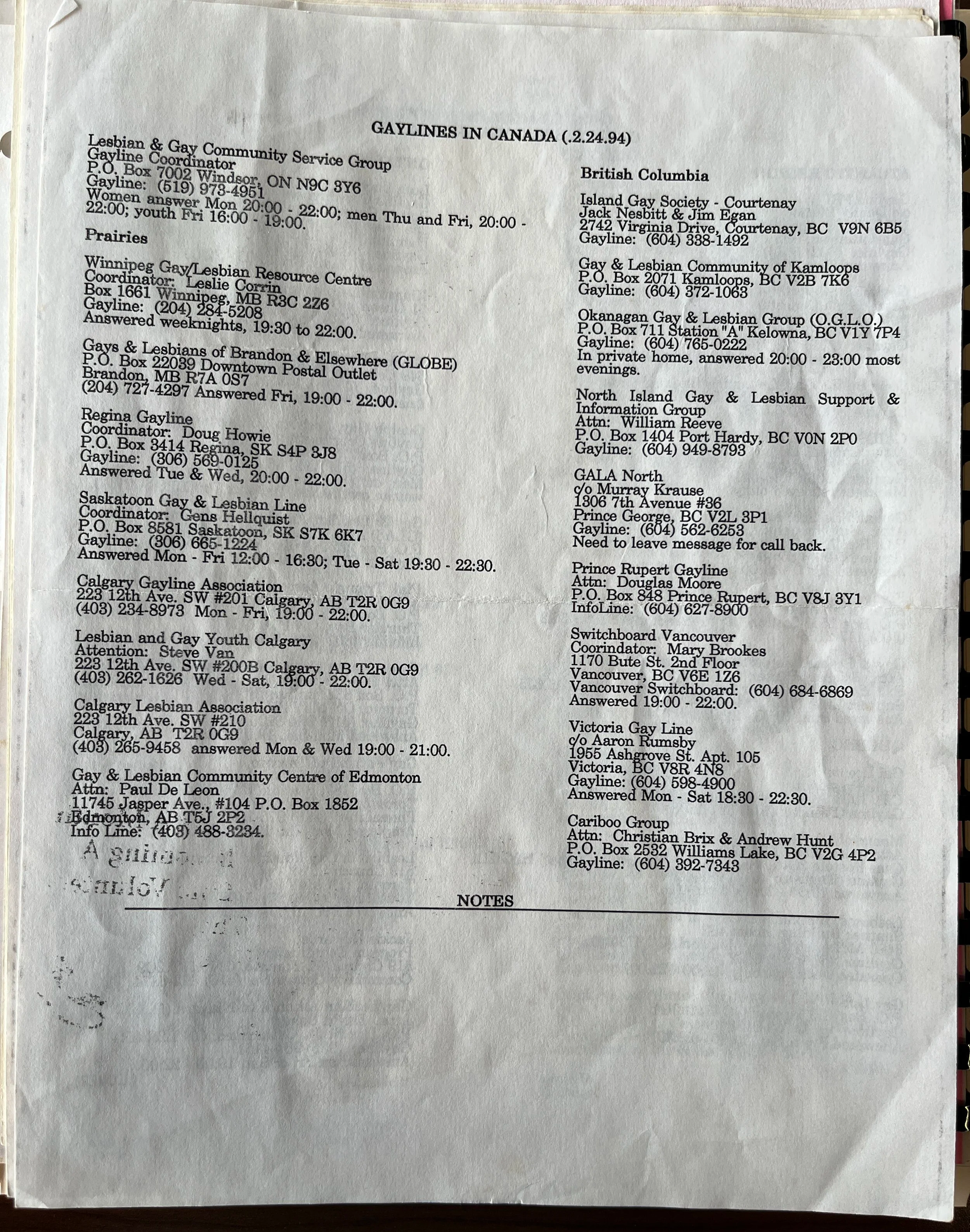
Brochure Providing Information on North American Queer Phone lines, 1994.
Phone lines were also beneficial in creating community relationships amongst other organizations by linking phone lines to each other to form a network of queer organizations across Canada. Phone lines often shared spaces and members; for example, the Gay Community Calendar (923-GAYS) was created by TAG member Harvey Hamburg, and although it was a separate endeavour, 923-GAYS shared an office with TAG for many of their operational years [10]. Beyond this, some of the most prolific Black queer activists in Toronto, including Douglas Stewart and Makeda Silvera, met working at the Black Youth Hotline run out of the Immigrant Women’s Centre on College Street [11]. National conferences also connected groups with phone lines and provided them with ties to a broader LGBTQ2+ community in Canada, such as Connexions, the conference for lesbian and gay phone lines in Atlantic Canada that took place in the summer of 1983 [12]. In this way, phone lines can be compared to social media platforms, which today is often the first point of contact that many young, closeted queer people have with the queer community due to its accessibility and anonymity. Though technology has advanced and methods have changed, the desire to make contact with the queer community in a safe environment remains.
While many calls led to conversations focused on the problems and anxieties around non-normative sexual and gender desires, gay phone lines also promoted and discussed the beauty, joy, and potentiality of queerness. For example, lesbian phone lines offered counselling for queer women dealing with difficulties but also discussed “‘the good times of coming out [13].’” Phone lines also encouraged people to get out and have fun and the call logs themselves could be viewed as “an archive to the economies of care available” during this period [14]. There were also specific phone lines dedicated to putting people in contact with potential sexual partners, such as Cruiseline. McCaskell states “[i]n the midst of the AIDS crisis, there was nothing safer than telephone sex [15],” and Cruiseline provided this outlet for many queer men. In this way, certain phone lines provided an outlet for sexual connection and queer pleasure while maintaining physical safety in a time when sexual activity was widely perceived as dangerous.
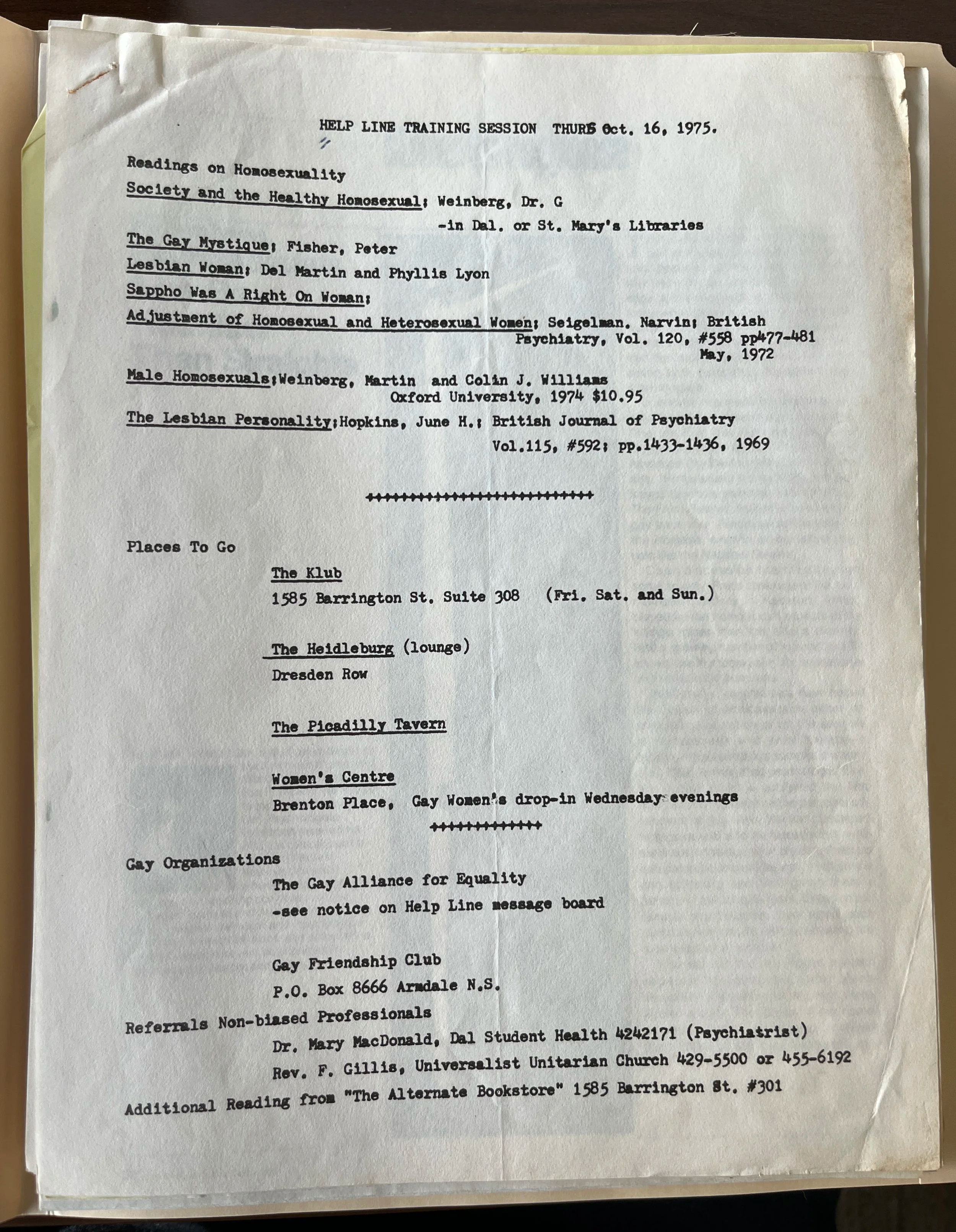
Document Outlining a Volunteer Training Session From 1975 (Gayline). Photo courtesy of Dalhousie Archives.
LGBTQ2+ phone lines were important sites of queer activism from the 1970s to the early 2000s. They provided callers with individual benefits such as community ties, emotional support, and a place to celebrate the positive aspects of being queer, while simultaneously creating a network of organizations across Canada. The work done by gay and lesbian phone line volunteers was a form of visibility politics for the queer community; they provided queer people with a safe space to come out, while also educating callers to combat the negative stereotypes that circulated about queerness. The evident sociopolitical power of phone lines combined with prevalent homophobia led to widespread barriers to community organizing. In spite of such obstacles, volunteers and organizers resiliently forged onward in the name of change. Though queer phone lines decreased in use and many eventually shut down in the 2000s due to a lack of funding, a decline in popularity, and high volunteer turnover, they remain integral to the history of gay liberation.
↓ Bibliography ↓
[1] McLeod, Donald W. Lesbian and Gay Liberation in Canada, 1976-1981, (Homewood Books, 2016), 107.
[4] Rebick, Judy. Ten Thousand Roses: The Making of a Feminist Revolution (Penguin Canada, 2005), 92.
[5] Zorzi, Peter. Queer Catharsis, 1990, www.onthebookshelves.com/qcmenu.html.
[6] Korinek, Valerie J. “‘The Torch of Golden Boy Burns Bright’: Winnipeg 1930-1969.” Prairie Fairies: A History of Queer Communities and People in Western Canada, 1930-1985. University of Toronto Press, 2018, 56-57, https://doi.org/10.3138/9781487518172.
[7] Chambers, Stephanie, et al. Any Other Way: How Toronto Got Queer. Coach House Books, 2017.
[8] Cait McKinney, Information Activism: A Queer History of Lesbian Media Technologies. (Duke University Press, 2020), 83.
[9] Korinek, Valerie J. “Wilde Times: Community and Organizational Development in Winnipeg, 1970-1985.” Prairie Fairies: A History of Queer Communities and People in Western Canada, 1930-1985. University of Toronto Press, 2018, 138, https://doi.org/10.3138/9781487518172.
[10] Rick Bebout. Promiscuous Affections: A Life in The Bar 1969-2000.
[12] “Gayline Report,” Sept. 1983, MS-15-11, GayLine Administrative Records, Ron and Bryan Garnett-Doucette fonds, Dalhousie University Archives, Halifax, NS.
[13] Korinek, Valerie J. “Wilde Times: Community and Organizational Development in Winnipeg, 1970-1985,” 130-131.