
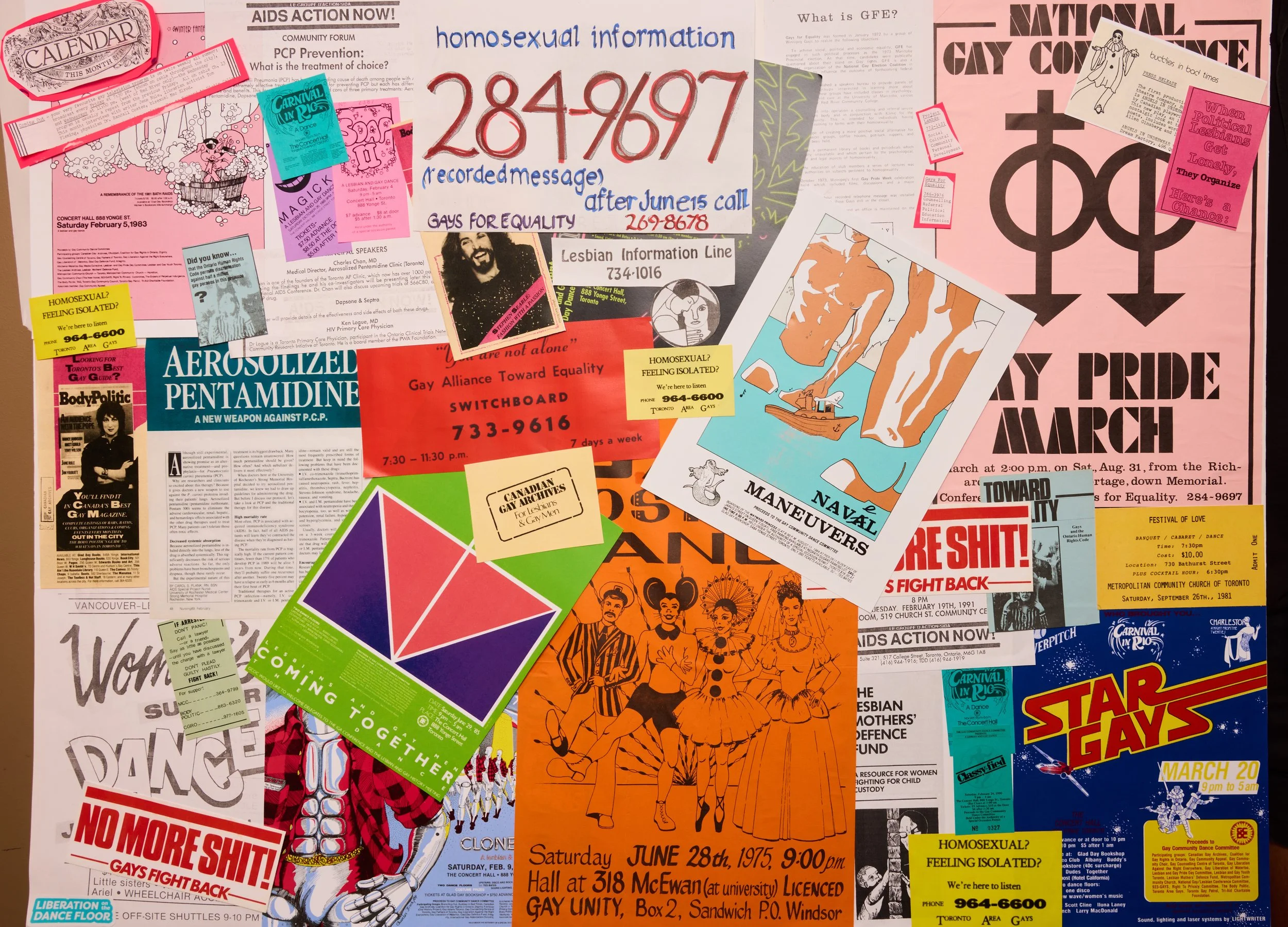

LESBIAN INFORMATION LINE - VANCOUVER, BC - CALL NOW:
(604) 734-1016
LESBIAN INFORMATION LINE - VANCOUVER, BC - CALL NOW: (604) 734-1016
The Pentamidine Project and its corresponding phone line were founded in March 1988 by the Toronto-based organization AIDS ACTION NOW! (AAN!). The purpose of the project was to provide people living with AIDS access to aerosolized pentamidine, a medication that could treat and help prevent serious cases of pneumocystis pneumonia (PCP), which was not yet available in Canada [1]. The program shut down less than a year later, in January 1989, when the government of Canada created the Emergency Drug Release Program (EDRP), making aerosolized pentamidine publicly available [2].
AIDS ACTION NOW! (AAN!) was founded in 1988 in response to the desperate need for treatment options—in particular aerosolized pentamidine, that were being denied or significantly limited by the Canadian government. Historian and archivist Donald W. McLeod notes: Early organizers of AAN! included Russell Armstrong, Wayne Boone, Denis Conway, Alan Dewar, Michael Hulton, Gary Kinsman, Michael Lynch, Tim McCaskell, James McPhee, and George Smith. Lynch acted as AAN!’s first chair until later in 1988, when he was hospitalized for PCP; Tim McCaskell became interim chair until October 5, 1988, when he was [officially] appointed chair [3].
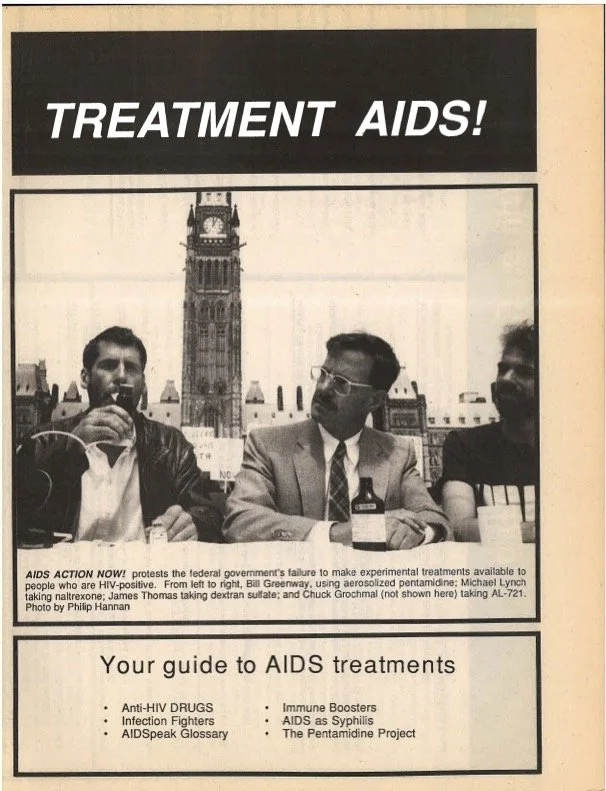
Pentamidine Project Flyer, AAN!.
AAN! ran a newsletter, staged protests, and set up the Pentamidine Project, which was “a form of direct action” that used a phone line to relay information and connect people living with AIDS to prescriptions, funding, and even carpools to Buffalo where aerosolized pentamidine was legal and available [4].
Tim McCaskell describes the development of the program in his book Queer Progress: From Homophobia to Homonationalism:
For three hundred dollars, less than the cost of one day in hospital, we developed information packages and set up a phone line to explain how to get a prescription and where to purchase the drug in Buffalo, a two-hour drive from Toronto. In April 1988, we distributed the packages to doctors’ offices, AIDS service organizations, and hospitals across the city. We set up a carpool to shuttle people across the border. We liaised with ACT and the PWA [AIDS Committee of Toronto and People With AIDS] foundation to make sure that there was funding for those who couldn’t afford the cost of the drug. Dr. Boone volunteered to supervise. Within a few months, forty people were attending a busy Thursday clinic to inhale the drug [5].
The Pentamidine Project’s speed and efficacy was evident in how quickly its broader activism made it redundant; thanks to the program’s impact on government policy, it was phased out by the following January. By February of 1989, an article in The New York Times was already suggesting that Canadian drug programs could help Americans access pentamidine, the inverse of the original goal of the Pentamidine Project [6]. Through the work done over the phone line, the Pentamidine Project empowered community members living with AIDS with necessary medical information that they were regularly barred from due to stigma and repression of the epidemic. Their work was so efficient, that it quickly became obsolete as it forced the Canadian Government to respond to the demand for lifesaving drugs such as aerosolized pentamidine.
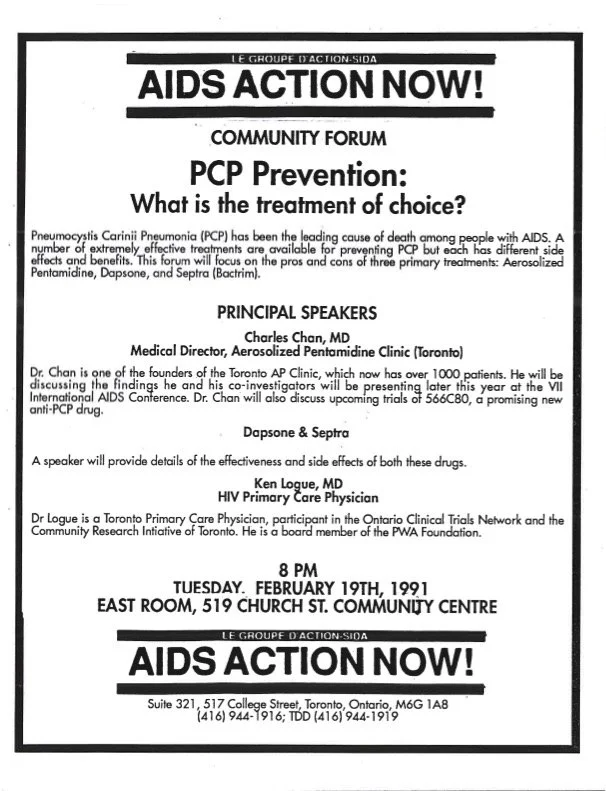
AAN! Flyer.
A large part of AAN!’s activism in the Pentamidine Project focused on the use of placebo trials, specifically the 1988 aerosolized pentamidine trial at Toronto General Hospital [7]. AAN! argued that the use of a placebo control group in trials for drugs such as aerosolized pentamidine, that without which a patient with or susceptible to PCP would be much more likely to die,was unethical and would constitute withholding lifesaving care [8]. In response, AAN! staged a die-in at Toronto General, with caskets on display to represent the placebo participants who would almost certainly die without treatment, were a central part of the protest. At the time, the Canadian government required these trials for the approval of new drugs, and without approval doctors could not legally prescribe or administer it in the Canadian medical system. It was this lack of availability that made the Pentamidine Project necessary and, as Gary Kinsman points out in his AIDS Activist History Project interview,
[…] getting aerosolized pentamidine into people’s bodies and preventing pneumocystis carinii pneumonia was a really important initial contribution that AIDS ACTION NOW! undertook. And it doesn’t mean that everyone who needed it was getting it, but it was a form of direct action. We were actually getting a treatment that was not sanctioned at all in the Canadian context outside of the clinical trial that was going on [9].
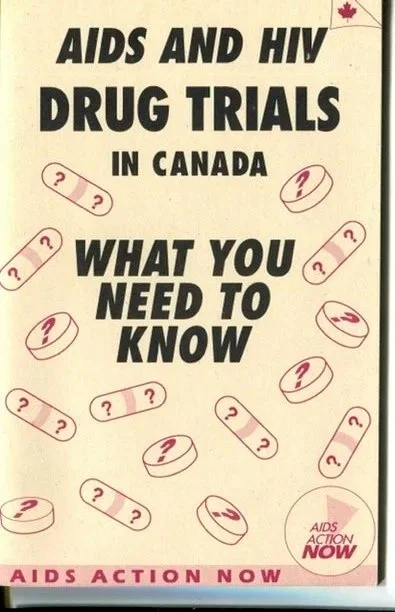
AAN! Drug Trials Pamphlet.
Although the Pentamidine Project’s scope was limited, both temporally and in terms of the number of participants, it was the founding force behind AAN!, and it helped to push forward an important change in Canadian drug policy which gave increased access to lifesaving treatments far beyond the small clinic in Toronto.
↓ Bibliography ↓
[1] McLeod, Donald W. HIV and AIDS in Toronto: A Selected Annotated Chronology: 1981–1990. (Homewood Books, 2025), 192, 205, 211–212.
[2] Ibid., 211–212, 272–273, 278.
[4] Gary Kinsman and Alexis Shotwell, “Interview Transcript 04,” AIDS Activist History Project, February 28, 2014, 11. https://www.aidsactivisthistory.ca/wp-content/uploads/2019/11/aahp-gary-kinsman.pdf.
[5] Tim McCaskell, Queer Progress: From Homophobia to Homonationalism (Between the Lines, 2016), 250.
[6] Kolata, Gina. “Canadian Program Could Help Sick Americans Obtain Experimental Drugs.” The New York Times. February 26, 1989, A28.
[7] McLeod, HIV and AIDS, 216–217.
[8] Gary Kinsman, The Regulation of Desire: Queer Histories, Queer Struggles, 3rd ed. (Concordia University Press, 2024), 268–69.